Police Say Search for Savannah Guthrie’s Mother Is Now a Criminal Investigation
Authorities in Arizona say the search for Savannah Guthrie’s mother is now being treated as a criminal investigation after evidence was found at her home.
Investigators said the 84-year-old did not leave on her own, prompting a shift away from a routine missing-person search.
No suspect has been identified, but officials said the change in classification alters how evidence is handled and how quickly decisions must be made.
That shift matters because it changes how time is treated. Searches based on welfare checks operate differently from investigations driven by criminal suspicion. Once that line is crossed, decisions made early begin to lock in how evidence is preserved, tested, and interpreted later.
Nothing has been resolved. No suspect has been named. Authorities have not said what, specifically, prompted the reclassification. But the posture of the search has changed, and with it, the pressure surrounding every next step.
The investigation is being led by the Pima County Sheriff’s Department, which said the decision was based on conditions observed at the residence. Officials have not described whether those conditions involved forced entry, violence, or something less visible.
:max_bytes(150000):strip_icc():focal(749x0:751x2)/savannah-guthrie-nancy-guthrie-020226-2-7d8c9c967da34f2e80fbdf4099bedbe4.jpg)
Savannah Guthrie's Mom's Friend from Church Reported Her Missing to Children
That lack of detail is deliberate. Once a case is treated as criminal, information control becomes part of the investigation itself. What is shared publicly is weighed against the risk of compromising evidence or narrowing options too early.
The immediate pressure now sits with timing. Criminal investigations depend heavily on early windows, when physical traces are freshest and witness memories are least degraded. Delay doesn’t stop a case, but it quietly reduces what can still be verified.
For people living nearby, the shift carries a different weight. A missing-person search can feel distant. A suspected crime introduces uncertainty about proximity and safety, even when authorities say there is no known threat to the public.
No alerts or warnings have been issued. Still, the change in classification alters how the situation is felt locally, moving it from concern into unease without providing clarity.
Behind the scenes, the scope of the investigation expands while the margin for error narrows. Criminal classification opens access to additional investigative tools, but it also introduces legal constraints that didn’t apply before.
Search efforts continue, but under stricter standards. Evidence handling becomes more controlled. Statements are more limited. Coordination with prosecutors begins earlier, even without charges on the table.
The family’s role changes as well. Public appeals are often central in missing-person cases. In suspected criminal investigations, families are sometimes asked to step back so messaging does not interfere with evidence gathering.
From the outside, that restraint can look like inactivity. In practice, it often signals the opposite — work moving inward, away from public view.
This case also fits a broader pattern. More investigations now shift classification mid-search as early assumptions give way to new information. Those transitions are rarely clean.
Each shift resets expectations. Timelines change. The language used by authorities becomes narrower. What people thought they were following becomes something else.
For law enforcement agencies, those moments carry added scrutiny. Early investigative choices are later examined closely, sometimes years after the fact. That awareness shapes how cautiously information is released now.
Authorities have asked anyone with information to come forward. That request carries greater weight once criminal suspicion is introduced, but it also raises the stakes for accuracy. Tips that once seemed benign can now have legal consequences.
Age adds another layer of urgency. Searches involving elderly individuals already operate under compressed timelines. When criminal suspicion enters the picture, those timelines tighten further.
Despite that pressure, officials have avoided offering theories or narratives. They have not described motives or scenarios. That restraint reflects how much remains unknown.
Nothing has been ruled out. Nothing has been confirmed.
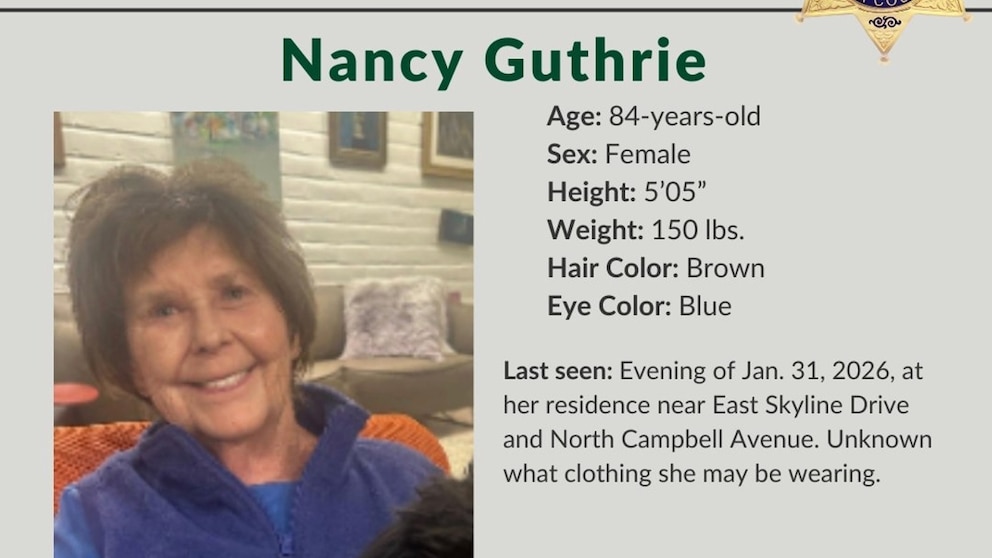
Arizona authorities say the search for Savannah Guthrie’s mother is now being treated as a suspected crime after evidence was found at her home.
For the public, the hardest part is the waiting. The investigation is active, but its most consequential movements are invisible. The absence of updates can feel like stalling, even as decisions are being made.
For the family, the uncertainty cuts differently. A missing-person case leaves space for hope. A suspected crime introduces fear without answers, replacing one kind of waiting with another.
This is where the case now sits — unresolved, tightened, and constrained. The system has shifted into a mode that prioritises evidence and timing over reassurance.
The search continues, but the context has hardened. The investigation is no longer about locating someone who may have wandered or become lost. It is about determining what happened, and whether someone else was involved.
That distinction reshapes every decision that follows. Early choices begin to carry weight that cannot be undone later.
Nothing has concluded. The pressure has shifted forward in time, and the window for clarity is narrowing without answers.
FAQs
Why are authorities treating the search as a suspected crime?
Investigators said conditions observed at the residence prompted them to treat the disappearance as potentially criminal. They have not publicly described the specific evidence that led to that determination.
What changes when a missing person case becomes a criminal investigation?
Once a case is treated as criminal, evidence handling becomes more controlled, information is released more selectively, and investigative decisions carry legal implications that do not apply in welfare-based searches.
Who is leading the investigation in Arizona?
The investigation is being led by the Pima County Sheriff’s Department, which is coordinating search and investigative efforts.
Have authorities named any suspects?
No suspects have been identified, and no arrests have been announced. Officials have said the case remains active and under investigation.
Is there a public safety risk related to the investigation?
Authorities have not issued any public safety warnings or alerts. They have not indicated that there is a known threat to the public at this time.