Beyoncé at $1.3 Billion: The Economic Trigger That Eliminated the ‘Success Tax’
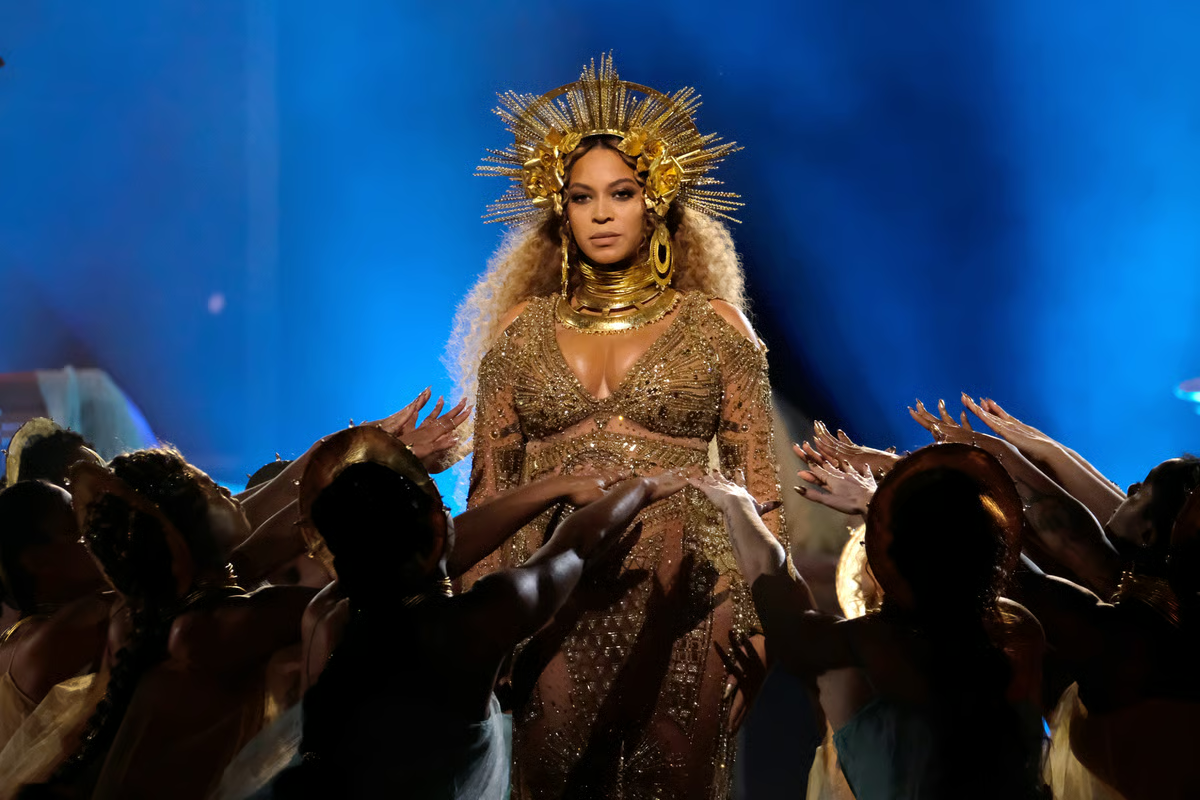
In December 2025, a seismic shift occurred in the valuation of global entertainment assets: Beyoncé officially crossed the billionaire threshold with a net worth of $1.3 billion.
This was not a "slow burn" accumulation of royalty checks. It was an Economic Trigger pulled by the unprecedented structural success of the Cowboy Carter era, which generated a staggering $148 million in personal windfall within a single calendar year.
While the media focuses on the music, the Punchline for the global C-Suite is far more clinical: Beyoncé has successfully transitioned from being a high-paid "employee" of the music industry to being its primary landlord.
By self-funding her productions through Parkwood Entertainment, she effectively executed a Middleman Purge, eliminating what we call the "Success Tax"—the 15% to 30% leakage traditionally paid to external agencies, promoters, and management firms.
This is the Hybrid Authority model in its final form. Most superstars are comfortable being the "flagship" of an external fleet; Beyoncé built her own fleet and then rented the ocean back to the industry. Her 2025 earnings didn't just come from selling art; they came from capturing the Residual Margin that usually disappears into the balance sheets of Live Nation, CAA, or WME. She didn't just "work harder"—she changed the math of fame.
How Beyoncé Rebuilt the Cost of Fame into a Private Asset Class
The core of the Parkwood strategy is the Verticalization of the Commission. In the traditional "Old Way," an artist is a cost center that distributes its revenue across a web of service providers. Beyoncé’s New Way treats every service provider as an internal department, turning an Expense into a Private Asset.
The Power Delta: Breaking the "Old Way"
In 2010, Beyoncé’s decision to sever ties with external management was viewed as a creative risk. In 2026, it is recognized as a Liquidity Moat. By bringing A&R, tour production, and film distribution under the Parkwood roof, she effectively established a Chokepoint Veto over her own costs.
| Revenue Stream | Traditional Artist Model ("Old Way") | Beyoncé’s Parkwood Model ("New Way") | The Power Delta |
| Management Fees | 15–20% Gross Commission | 0% (In-house staff on salary) | +20% Retained Margin |
| Touring Profits | 50–60% (After promoter/agency cuts) | 80–85% (Self-produced) | +25% Asset Recovery |
| Master Royalties | 15–20% (Standard label split) | 70–80% (Ownership via Parkwood) | Full Equity Control |
| Merchandise Split | 50–60% to the artist | 85–90% (In-house fulfillment) | Elimination of "Success Tax" |
Information Gain: The Logistics of Supremacy
Beyoncé’s business dominance is fueled by Information Gain—the proprietary data generated by owning your own supply chain. Because Parkwood manages the 100 semi-trucks and 8 cargo planes (747s) required for the Cowboy Carter tour, Beyoncé has a granular understanding of logistics that a "talent-only" artist lacks.
She has weaponized her business data to protect her margins. By knowing the exact cost of fuel, crew lodging, and equipment transport, she can out-negotiate any venue. This isn't just "being organized"; it's Operational Sovereignty. She has realized that in a high-inflation environment, the person who owns the trucks makes more than the person who holds the microphone.
The Success Tax Eradication
Most stadium acts lose a staggering percentage of their revenue to third-party logistics firms and local promoters. Beyoncé, acting as her own promoter, kept the Full Stack Profit. This structural change allowed her to fund high-risk visual experiments like Lemonade and Cowboy Carter without needing a bank’s permission or a label’s approval. She has moved beyond "royalty checks" and into Generational Residuals.
The LVMH Play: Choosing Equity Over the Traditional Endorsement Tax
The Parkwood model has evolved beyond the music industry’s borders. Beyoncé is no longer just "event-izing" her albums; she is building Exit-Ready Assets—companies designed with the same rigorous vertical integration as her music empire. This is the Venture Gambit, a shift from being a "Face" to being a "Founder."
The Scarcity Scale: Mastering "Event-ized" Pricing
In 2025, Beyoncé shattered the "Volume Trap." Traditional artists believe they must tour 100+ cities to maintain relevance. Beyoncé played just 32 exclusive stadium dates. By intentionally strangling supply, she transformed every concert into a global pilgrimage.
This was a calculated Logistical Power Move. By concentrating her 32 dates into just 9 strategic global hubs (Mini-Residencies), she slashed the astronomical overhead of cross-country transport. Scarcity became her pricing engine. This "High-Margin, Low-Volume" strategy allowed her to capture a $407.6 million gross while working a fraction of the time required by her peers.
The LVMH Alliance: Equity Over Endorsement
Her 2024 launch of SirDavis whiskey in partnership with Moët Hennessy (LVMH) represents the "New Way" of celebrity enterprise. While others sign licensing deals for a small percentage of sales, Beyoncé entered as a Founding Partner.
This move provides her with a Liquidity Moat backed by the world’s largest luxury conglomerate. She gains LVMH’s elite distribution network while maintaining Majority Equity. Combined with her hair care brand Cécred, she is building a portfolio of high-margin luxury goods that could eventually be sold for ten figures, mimicking the "Fenty Playbook" to ensure her billionaire status is decoupled from her ability to perform.
The "So What?" Action Roadmap for CEOs
-
Audit Your Commission Leakage: Identify where you are paying a "Success Tax" to external agencies for tasks that could be internalized. Verticalize your highest costs.
-
Weaponize Your Logistics Data: Don't outsource your supply chain intelligence. Ownership of the "middle" (the logistics) is where the Information Gain—and the profit—is hidden.
-
Prioritize Equity Over Fees: Stop selling your brand for a "royalty." Build your own infrastructure to capture the Residual Value and future exit potential.
Key Takeaways Box: The Billionaire Blueprint
-
Vertical Integration: Parkwood Entertainment is a "Full-Stack" firm that captures the 20% commission usually lost to outsiders.
-
Market Gravity: "Beyflation" proves that at a certain scale, the creator becomes the market, dictating prices to venues and cities.
-
Content as Infrastructure: Marketing isn't an expense; it’s a profit center. Selling a concert film directly to theaters (AMC) bypasses the "Studio Tax."
People Also Ask (FAQs)
-
How did Beyoncé become a billionaire in 2025? Through the vertical integration of Parkwood Entertainment and owning 100% of her tour production and masters.
-
What is the "Beyflation" effect? The surge in local hotel and transport prices (up to 178%) caused by her highly concentrated stadium residencies.
-
How much did Netflix pay Beyoncé for the Christmas 2024 show? An estimated $50M, which covered both the performance and production, allowing her to keep the net profit.
-
What companies does Beyoncé own? Parkwood Entertainment, Cécred (Hair Care), and SirDavis (Whiskey), alongside her music catalog.
-
Why does she play fewer shows than other artists? To create extreme scarcity, driving up ticket prices and reducing logistical overhead.
-
Is Beyoncé the richest musician? As of 2026, she is among the top five, alongside Taylor Swift and Jay-Z.
-
How does SirDavis differ from other celebrity spirits? It is a "Founding Partner" joint venture with LVMH, not a licensing deal.
-
What is the "Success Tax"? The 15-30% cut traditionally taken by managers and agencies from an artist's gross income.
Tags: Beyoncé, Parkwood Entertainment, Billionaire Strategy, Vertical Integration, Beyflation, Cowboy Carter Tour, Business of Music, LVMH, SirDavis, CEO Strategy