
Arkadi Khachaturian
Entrepreneur in automotive accessories manufacturing
In the context of the modern competitive economy, a company’s ability to deliver fast and in-demand innovations becomes a determining factor in its long-term viability. Traditional product development models, based solely on internal research, are giving way to more flexible, consumer-oriented approaches. Customer feedback, long considered primarily as a tool for service improvement, is today recognized as a valuable resource for strategic development. The relevance of the topic is driven by the growing volume of unstructured data received from users through digital channels and the need for their systematic processing. The absence of a formalized system for working with this data leads to the loss of valuable ideas and keeps the innovation process chaotic.
The purpose of this article is to present and justify a systematic model for using feedback to generate continuous product innovations.
The concept of involving consumers in the value creation process is not new. One of the fundamental approaches is the "Voice of the Customer" (VoC) theory, which involves the systematic collection and translation of customer needs and expectations into product engineering specifications [1]. This approach ensures that the developed product corresponds to the real demands of the market.
This idea was further developed in the concept of "open innovation," according to which companies can and should utilize external ideas alongside internal ones [2]. In this context, consumers are considered not as passive recipients but as active co-creators of value. Special significance is given to so-called "lead users," who anticipate market trends and independently develop solutions for needs that have not yet emerged in the mass market. Research by Eric von Hippel shows that innovations initiated by such users often have higher commercial potential [3]. Thus, the theoretical foundation implies a transition from studying consumers to directly collaborating with them in innovation activities.
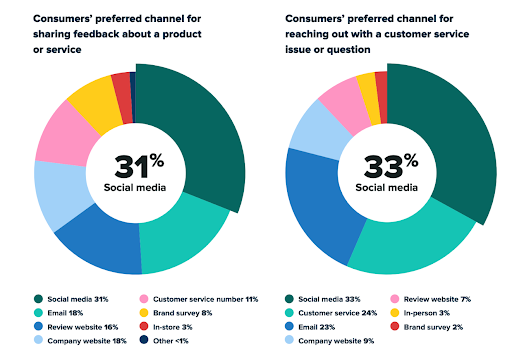
Systematic Model for Working with Feedback
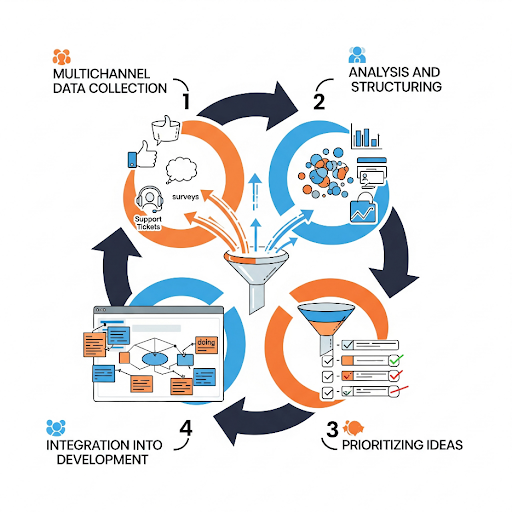
To transform disparate feedback into concrete product solutions, a structured and repeatable process is required. The proposed model consists of four sequential and cyclically repeating stages.
Stage 1: Multichannel Data Collection.
Information from consumers comes from various sources: direct surveys, reviews on websites and social media, support service data, focus groups, and user testing. The company’s task at this stage is to aggregate all this data into a single system, for example, a CRM or a specialized feedback management platform.
Stage 2: Analysis and Structuring.
The collected data, mostly unstructured, requires processing. Using natural language processing (NLP) and semantic analysis technologies, feedback can be automatically classified by topic, sentiment can be determined, and the most frequently mentioned problems or requests can be identified. The result of this stage is a structured dataset suitable for further analysis.
Stage 3: Idea Prioritization.
Not all user requests can or should be implemented. At this stage, ideas are evaluated based on a set of criteria, such as alignment with company strategy, potential impact on business metrics (for example, customer retention or average order value), technical complexity of implementation, and the number of users expressing a similar need. Methods such as RICE (Reach, Impact, Confidence, Effort) can be used for prioritization.
Stage 4: Integration into the Development Process.
Selected and prioritized ideas are transformed into concrete tasks for product and engineering teams. They are included in the product roadmap and implemented within iterative development cycles, for example, using Agile or Scrum methodologies. An important element of this stage is informing users that their feedback has been heard and has led to changes, which closes the feedback loop and encourages further participation.
Organizational and Technological Support
Implementing the described model requires not only technological tools but also certain organizational changes. A successful feedback management system implies cross-functional interaction between marketing, support, sales, and development departments. Responsibility for the process should be clearly defined, for example, in the role of a product manager or a dedicated customer experience analysis team.
The company culture should encourage openness to criticism and a data-driven approach in decision-making. Management needs to demonstrate the importance of feedback by publicly acknowledging the contribution of customers to product development. This helps cultivate a customer-centric mindset at all levels of the organization. The technological stack supporting the system may include CRM systems for data aggregation, platforms for conducting surveys, text analysis tools, and specialized software for managing ideas and product roadmaps.
Systematic use of customer feedback is a powerful catalyst for continuous innovation. Transitioning from passive collection of feedback to a proactive system for integrating it into development allows companies to create products that more accurately meet market needs, thereby achieving sustainable competitive advantage.
The presented four-stage model — collection, analysis, prioritization, integration — represents a universal framework that can be adapted for organizations of different scales and industries. Its successful implementation depends on three components: a clearly defined process, support from modern technologies, and the development of an appropriate organizational culture. Ultimately, companies that learn to effectively “hear” their customers and transform their voice into new products lay the foundation for long-term growth and development.
References
- Griffin, A. The Voice of the Customer / A. Griffin, J. R. Hauser // Marketing Science. – 1993. – Vol. 12, № 1. – P. 1–27.
- Chesbrough, H. W. Open Innovation: The New Imperative for Creating and Profiting from Technology. – Boston: Harvard Business School Press, 2004. – 272 p.
- Von Hippel, E. Democratizing Innovation. – Cambridge, MA: MIT Press, 2006. – 216 p.
- Ries, E. The Lean Startup: How Today's Entrepreneurs Use Continuous Innovation to Create Radically Successful Businesses. – New York: Crown Business, 2011. – 336 p.