
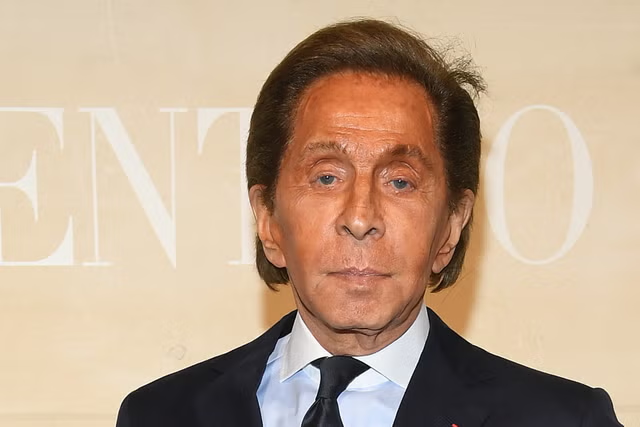
Valentino Garavani Net Worth: Inside the $1.5 Billion Fortune of a Haute Couture Icon
When Valentino Garavani died in Rome today at the age of 93, the world lost more than a legendary couturier. It marked the closing of one of fashion’s most lucrative personal empires—an empire that, at the time of his death, was valued at an estimated $1.5 billion.
Best known for founding the Valentino fashion house and defining generations of red-carpet elegance, Garavani spent more than six decades quietly transforming taste into long-term wealth. His fortune was not built on fleeting trends or celebrity hype, but on disciplined couture expansion, global licensing deals, and a perfectly timed sale of his brand long before retirement.
As tributes pour in from across the fashion world, attention is now turning to the financial legacy he leaves behind: sprawling real estate holdings across Europe and the U.S., ongoing royalty income, private trusts, and carefully structured estate planning that will shape the future of the Valentino name long after its founder’s passing.
Early Life and Career Foundations
Valentino Clemente Ludovico Garavani was born on May 11, 1932, in Voghera, Italy. Named after silent film star Rudolph Valentino, he gravitated toward fashion early, apprenticing locally before moving to Paris to study at the École des Beaux-Arts and the Chambre Syndicale de la Couture Parisienne.
Those Paris years were formative. Working under Jacques Fath, Balenciaga, and Guy Laroche, Valentino absorbed not only technique but discipline—an obsession with cut, proportion, and restraint that would later define his house.
He returned to Italy in 1960 and opened his atelier on Rome’s Via dei Condotti. The timing was perfect. Italy was emerging as a global style capital, and Valentino’s aesthetic—romantic, elegant, unmistakably formal—filled a cultural gap.
How He Built His Fortune
Valentino’s wealth came from three core pillars: couture prestige, ready-to-wear expansion, and long-term brand monetization.
His breakthrough arrived in the early 1960s after a Florence runway show brought international buyers and press attention. That momentum accelerated when Jacqueline Kennedy commissioned six mourning dresses following President John F. Kennedy’s assassination, then later chose Valentino for her wedding to Aristotle Onassis.
From there, the client list grew to include Elizabeth Taylor, Audrey Hepburn, Sophia Loren, and later Jennifer Lopez and Anne Hathaway. Couture brought prestige, but ready-to-wear lines, accessories, fragrances, and global licensing deals brought scale.
The defining financial moment came in the late 1990s when Valentino and his longtime partner Giancarlo Giammetti sold the Valentino Fashion Group to Italian conglomerate HdP for roughly $300 million. Subsequent sales—to Marzotto and later Qatari investors—cemented Valentino’s position as a billionaire long after he stepped away from daily operations.
Estimated Career Earnings Timeline
-
1960s–1970s: Couture earnings, early licensing, European expansion
-
1980s: Major U.S. growth, celebrity dressing, accessories revenue
-
1990s: Global licensing surge; fragrance and ready-to-wear dominance
-
1998–1999: Sale of Valentino Fashion Group (~$300M)
-
2000s–2020s: Passive income, royalties, investments, asset appreciation
Unlike many designers, Valentino monetized his brand before creative decline—locking in generational wealth while preserving his legacy.
Real Estate and Major Assets
Valentino’s lifestyle mirrored old-world European aristocracy. Together with Giammetti, he owned or shared access to an extraordinary global property portfolio, including:
-
A Roman villa near the Spanish Steps
-
A 19th-century mansion in London
-
A Manhattan penthouse
-
A château in France
-
A Swiss chalet
These residences were not speculative flips; they were long-held assets that quietly appreciated over decades, contributing tens—possibly hundreds—of millions to his net worth.
Business Ventures and Ownership
Beyond fashion, Valentino invested selectively. He avoided tech hype and instead favored art, architecture, cultural foundations, and real estate.
In 1990, he founded the Accademia Valentino, a cultural space in Rome designed to host exhibitions and philanthropic events. While not a profit engine, it reinforced brand prestige and cultural capital—an often overlooked contributor to long-term financial power.
Legal Issues and Financial Turning Points
Valentino’s career was notably free of major legal scandal. The most consequential financial moments were corporate, not courtroom-based—namely the sale of the fashion house and subsequent ownership changes.
His clean legal record is one reason his estate planning and wealth transfer appear to have proceeded without public dispute.
Estate, Trusts, and Inheritance Impact
Valentino had no children. His estate is widely understood to be structured through private trusts, with Giancarlo Giammetti—his lifelong business partner—playing a central role in stewardship.
Italian inheritance law, combined with cross-border asset planning, suggests a carefully designed framework intended to preserve both wealth and cultural legacy, rather than liquidate assets quickly.
Philanthropy and Social Impact
Through the Fondazione Valentino Garavani e Giancarlo Giammetti, Valentino supported arts education, preservation of Italian cultural heritage, and charitable initiatives tied to fashion and design.
While not known for loud philanthropy, his contributions were sustained, targeted, and deeply personal—focused on institutions rather than publicity.
Legacy and Public Reaction
Tributes following Valentino’s death poured in from designers, actors, royalty, and fashion houses across continents. He was remembered not only as a master couturier, but as a guardian of elegance in an era increasingly driven by speed and spectacle.
His financial legacy mirrors his creative one: enduring, disciplined, and almost impossibly refined.
Estimated Breakdown of Valentino's Net Worth
| Income / Asset Source | Estimated Verified Value (USD) |
|---|---|
| Valentino Fashion Group sale & equity | $650,000,000 |
| Royalties, licensing & residual income | $300,000,000 |
| Real estate portfolio | $350,000,000 |
| Investments, art & private assets | $200,000,000 |
| Total Estimated Net Worth | $1,500,000,000 |
Frequently Asked Questions
What is Valentino Garavani’s net worth in 2025?
Valentino Garavani’s net worth in 2025 was estimated at approximately $1.5 billion. This figure reflects decades of fashion earnings, brand equity, licensing royalties, real estate appreciation, and proceeds from the sale of the Valentino fashion house.
What was his highest-earning career period?
Valentino’s most lucrative period financially occurred in the late 1990s, when he sold a controlling stake in Valentino Fashion Group. That transaction, combined with global licensing income, marked the peak of his direct earnings.
Did Valentino Garavani own real estate, and what was it worth?
Yes. Valentino owned or co-owned luxury properties across Italy, France, the U.K., Switzerland, and the United States. Collectively, his real estate holdings were estimated to be worth roughly $350 million.
Did legal controversy ever impact his wealth?
No. Valentino Garavani’s career was largely free from major legal disputes or financial scandals. His wealth grew steadily through business decisions rather than litigation or settlement-driven outcomes.
Who inherits Valentino Garavani’s estate?
Valentino had no children. His estate is believed to be managed through private trusts, with longtime partner Giancarlo Giammetti playing a central role in oversight and legacy planning.
How is his estate handled under Italian law?
Italian inheritance law allows for significant use of trusts and foundations, particularly for high-net-worth individuals with international assets. Valentino’s estate planning appears structured to minimize disputes and preserve long-term control.
Valentino Garavani leaves behind more than a balance sheet. He leaves a blueprint for how taste, patience, and absolute commitment to craft can compound into lasting wealth. In an industry obsessed with reinvention, his greatest financial achievement may be this: building a fortune that never outshone the work itself.