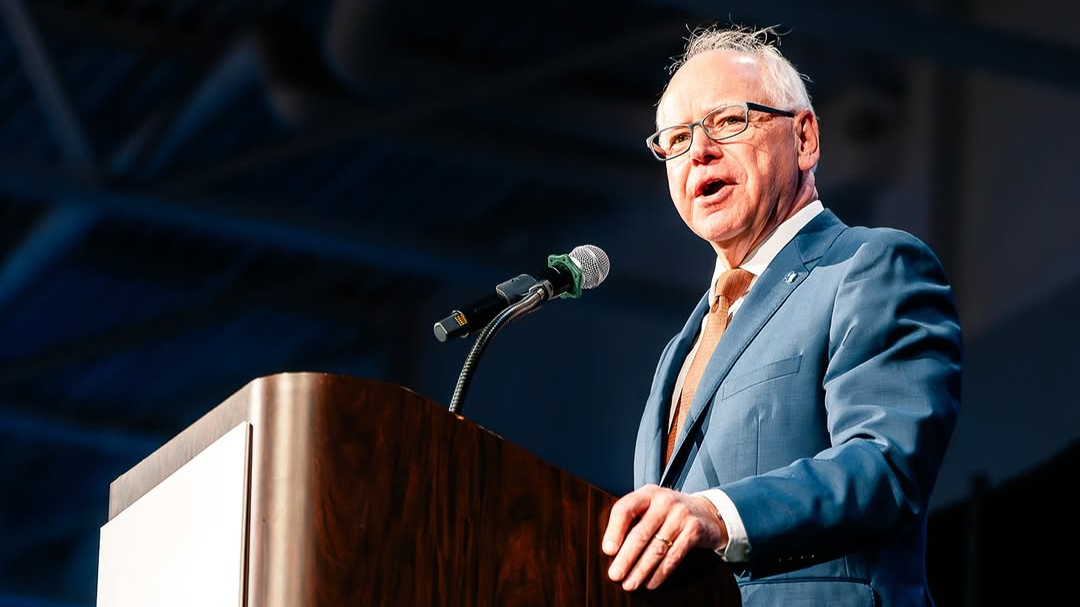
Tim Walz: An In-Depth Profile of a Teacher-Turned-Governor at the Center of America’s Political Conversation
Early Life, Upbringing and Education
Timothy James Walz was born on April 6, 1964, in West Point, Nebraska, and raised in a rural community where his father worked as a high-school administrator. His upbringing was steeped in Midwestern values, shaped by small-town life, close community ties, and the expectations of public service shared by teachers and school administrators. Walz graduated high school in a class of just 25 students — a detail he often cites to illustrate his connection to rural America and the community-first mentality that helped define his worldview.
The death of his father a year after his graduation forced Walz into adulthood quickly. He began taking on a variety of jobs — agricultural work, factory shifts, and later public-sector roles — experiences that grounded his political identity in the rhythms of working-class life. Despite the financial and emotional strain of that period, he pursued education and, in 1989, earned a bachelor’s degree in social science education from Chadron State College. After graduating, he spent a year teaching in China, an early international exposure that broadened his perspective and gave him firsthand insight into global cultural and political dynamics.
National Guard Service and the Foundations of Leadership
Parallel to his work life, Walz joined the Army National Guard at age 17 and ultimately served for 24 years, including stints in both Nebraska and Minnesota. His service was a defining part of his personal and professional identity. It taught him discipline, crisis readiness, and a deep respect for service members and their families. The National Guard experience also made him comfortable bridging disparate communities — rural voters, working families, military households, and students.
When Walz moved to Minnesota in 1996 with his wife, Gwen, he began work as a high-school geography teacher and football coach. His leadership qualities became quickly apparent. In 1999, he coached his team to a state championship — the school’s first — a point of pride he continues to reference. That same year, he agreed to serve as faculty adviser for a gay-straight alliance at a time when such a position could be politically and socially contentious. Walz has said that it was precisely because he was a married, football-coaching National Guard veteran that his support would matter. This willingness to stand with marginalized students foreshadowed the inclusive values that would later define his political career.
Entry into Politics and the Road to Congress
Walz’s political awakening occurred in 2004 during a school field trip to a presidential campaign event. When his students were denied entry, Walz interpreted it as an affront to civic learning and political engagement. That moment catalyzed his desire to run for office. He volunteered for the Democratic campaign that year and later enrolled in a political “boot camp,” a program honoring the late Senator Paul Wellstone that trained aspiring progressive candidates.
In 2006, Walz ran for Congress in Minnesota’s 1st District — a traditionally Republican seat — and won in a surprise upset. His victory signaled his ability to appeal to both rural conservatives and urban or suburban Democrats. During his six terms in the U.S. House (2007–2019), he cultivated a reputation as a practical and approachable legislator. He worked frequently on bipartisan initiatives, particularly those related to military families, education, and rural infrastructure. His moderate tone matched his district’s demographics, but as national politics shifted, so did some of his positions. A notable example was his evolution on gun policy: once rated “A” by the National Rifle Association, he later renounced the group and advocated for stronger gun regulations after mass shootings intensified political urgency on the issue.
Governor of Minnesota: Crisis Leadership and Bold Reforms
In 2018, Walz successfully ran for governor of Minnesota, taking office in January 2019. His tenure immediately intersected with historic events. The COVID-19 pandemic demanded swift statewide leadership, and Walz approached it with a public-health-first mindset, supporting school closures, emergency powers, and statewide mitigation measures. His approach drew both praise and criticism, reflecting the polarized climate around pandemic policy.
In 2020, the murder of George Floyd in Minneapolis triggered global protests and national scrutiny. Walz’s decision to deploy the Minnesota National Guard — after receiving a request from the Minneapolis mayor — was heavily debated. Supporters argued that he acted cautiously, prioritizing de-escalation, while critics claimed he mobilized too slowly. The moment underscored the complexity of governing during civil unrest and revealed the tension between Walz’s military background and his progressive coalition.
After Democrats gained control of both legislative chambers in 2023, Walz presided over one of the most ambitious periods of Democratic policymaking in Minnesota’s history. His administration enacted sweeping reforms: expanded abortion protections, universal free school meals, legalization of recreational cannabis, expanded rights and access for undocumented residents, and new gun control legislation. These accomplishments solidified Minnesota’s status as a progressive leader and elevated Walz’s national profile.
A National Figure: The 2024 Vice-Presidential Nomination
In August 2024, Walz was launched into national prominence when Kamala Harris selected him as her running mate in the presidential election. The choice surprised many political observers, who expected a more conventional pick — perhaps a senator, a swing-state moderate, or a nationally recognized political figure. Instead, Harris opted for a governor with deep middle-American roots and a career shaped outside the elite professional classes.
Walz embraced the role, positioning himself as a grounded, empathetic counterweight to the increasingly combative political climate. Despite a competitive race, the Harris–Walz ticket ultimately lost, and Walz returned to Minnesota to continue serving as governor. Even so, his national exposure significantly expanded his influence and cemented him as a potential future contender in Democratic politics.
A Rare Profile in Public Finance: Walz’s Modest Wealth
In sharp contrast to many of his peers in national politics, Walz’s financial disclosures reflect a modest, middle-class life. Estimates place his net worth between roughly $112,000 and $330,000 — exceptionally low for a governor, and even more unusual for a former vice-presidential nominee. He owns no major real-estate holdings, no large investment portfolio, and maintains a financial profile shaped largely by public-sector salaries and pension benefits from his decades as a teacher, National Guard member, and congressman.
His relatively limited personal wealth became a talking point during the 2024 campaign, with some analysts describing him as one of the least wealthy figures to seek the vice presidency in modern history. Supporters argue that this enhances his credibility as a public servant who has spent his career in classrooms and community roles rather than corporate boardrooms. Critics sometimes frame it as a lack of executive or private-sector experience. Either way, his financial status contributes to his public persona as an “everyday American” serving high office.
The 2025 Slur Controversy and Walz’s Response
In late 2025, Walz found himself at the center of a national news story when former President Donald Trump used a disability-related slur aimed at him. The remark drew swift condemnation, not only because of the increasingly toxic political rhetoric it represented, but because of its deeply personal implications. Walz is the father of a son with disabilities, including a nonverbal learning disorder, ADHD, and anxiety. In a statement covered by The Independent, Walz described the insult as “cruelness,” emphasizing that as both a longtime educator and a parent, he understood the harm such language could inflict — not just on targeted individuals, but on all families raising children with disabilities.
The incident reignited discussions about the boundaries of political discourse, the treatment of disability in public conversation, and the role of decency in American leadership. For Walz, the moment was not simply political theater but a reminder of the personal stakes many families face. It also underscored one of the enduring themes of his career: empathy as a governing principle.
Legacy, Impact, and What Comes Next
Tim Walz’s story is unusual in modern American politics. He is not a wealthy businessman or a career Washington insider. He is a teacher, a coach, a soldier, and a public servant shaped by rural America and by the everyday concerns of ordinary families. His ability to move between rural conservative districts, progressive urban constituencies, and national politics is part of what makes him an intriguing figure.
His governorship will likely be remembered for its major legislative reforms and its navigation of historic crises. His vice-presidential campaign marked him as a national leader with potential future ambition. And his personal experiences — as a father, educator, veteran, and public servant — continue to inform his decisions and deepen his connection with many voters.
Whether Walz seeks higher office again remains to be seen, but his influence is already felt in the shifting identity of the Democratic Party, the national conversation about decency and disability, and the evolving politics of the American Midwest. What is clear is that Tim Walz occupies a uniquely human place within the current political landscape — one defined not by wealth or pedigree but by service, empathy, and resilience.