
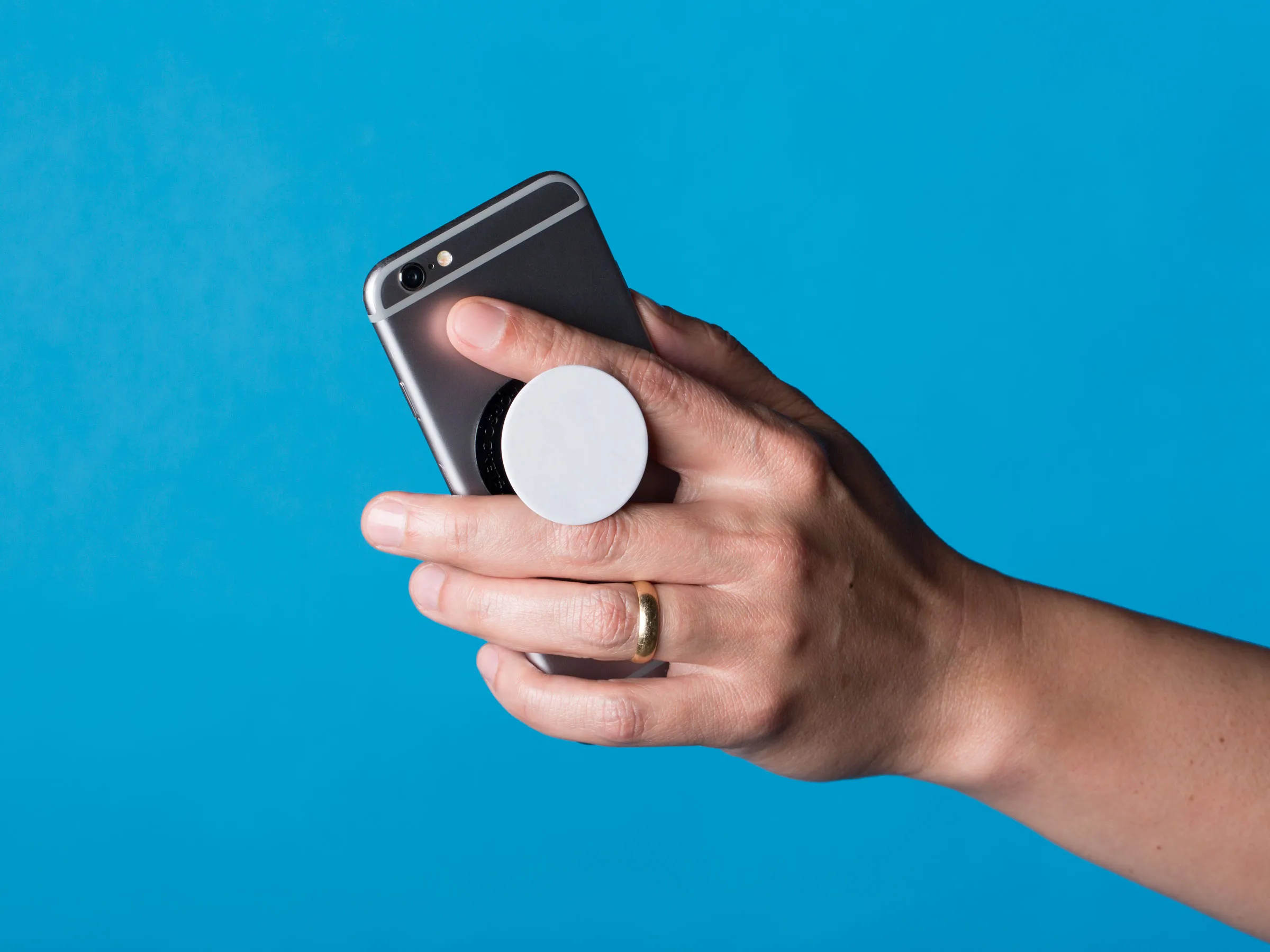
As PopSockets expands beyond its original grip into cases, wallets and customisable products, the company’s real breakthrough looks clearer than ever.
It did not simply invent a clever accessory. It found a piece of everyday life people had stopped noticing—the blank back of the smartphone—and turned it into something useful, expressive and commercially valuable.
PopSockets didn’t invent a new behaviour—it monetised one that already existed.
Most explanations focus on what PopSockets does. The real reason it worked is how often people use it.
That distinction explains why a product that began as a homemade fix for tangled earphones grew into a global brand that has sold hundreds of millions of units worldwide.
When founder David Barnett first experimented with the idea in 2011, he wasn’t trying to build a company. He was trying to solve a minor frustration. Working in his garage, he glued two buttons to the back of his phone so he could wrap his earphones around them. It looked crude, but it revealed something important: the back of the phone was unused space.

David Barnett, founder of PopSockets, whose simple phone accessory grew into a global business through everyday use
The back of the phone wasn’t just unused space—it became monetisable space.
That space turned out to be more valuable than the original problem he was trying to solve.
The first real signal came from a simple reaction. “My wife said it made her feel safer,” he said. That moment shifted the product from convenience to something more instinctive. It wasn’t just useful—it changed how the phone felt in the hand.
That shift is where most products either fail or break through.
After a modest Kickstarter campaign and early sales, Barnett brought the product to market. At first, he sold two units in a pack, positioning them as a cable-management solution. It didn’t resonate. When he switched to selling a single unit and focused on how it improved grip, usage and comfort, demand changed almost immediately. “I offered people half the product for the same price and just remarketed it, and it just blew up,” he said.
That moment is easy to overlook, but it reveals the real business model.
PopSockets didn’t win because it was clever. It won because it changed how people used something they already relied on.
After the early launch phase, the product didn’t behave like a typical accessory. It didn’t get used occasionally. It became something people interacted with constantly—every time they picked up their phone.
This is where the model becomes powerful.
A smartphone is already one of the most frequently used objects in modern life. PopSockets didn’t need to create new demand. It attached itself to an existing habit and made each interaction slightly easier.
People used it to hold their phone more securely. To text with one hand. To watch videos. To rest their device on a surface. To personalise it.
Each of those actions is small on its own. But they repeat.
And repetition is what builds value.
That’s why PopSockets looks like a cheap accessory—but behaves like a high-retention product.
The more it is used, the more familiar it becomes. And the more familiar it becomes, the harder it is to remove. At that point, the product is no longer something you bought. It becomes part of how you use your phone.
That is the point where a product crosses from utility into behaviour.
The growth followed that pattern.
The company moved from a garage project to a global retail presence within a few years, expanding across tens of thousands of stores and building a distribution network that included major retailers and the promotional products industry.
What accelerated the growth was not just demand, but how easily the product spread.
Barnett has described three drivers: celebrity visibility, school-level adoption and branded merchandise. Each one reinforced the same mechanism—visibility and repetition. When people saw others using the product, they understood it instantly. No explanation was needed.
That is another advantage of behaviour-driven products: they are self-demonstrating.
The back of the phone became more than functional space. It became visible space. A place for logos, designs and identity. That gave PopSockets two businesses at once—a consumer product and a marketing surface.
And once it reached that point, growth became easier to sustain.

PopSockets scaled to hundreds of millions of units by embedding itself into how people use their phones every day
Rapid growth, however, brings its own risks.
Scaling production, managing inventory and keeping up with demand created pressure behind the scenes. Like many fast-growing companies, PopSockets faced moments where demand could have outpaced its ability to supply.
But the underlying strength of the model held.
Because demand was not being driven by novelty—it was being driven by repeated use.
Novelty fades. Behaviour compounds.
As the company matured, it expanded beyond the original product.
What began as a simple grip evolved into a broader ecosystem—cases, wallets, mounts and, more recently, customisation tools that allow users to design their own products.
This expansion was not random. It followed the same logic as the original success.
Once PopSockets had established a position on the device, it could build around that position. The product was no longer just something attached to a phone. It was part of how the phone was used.
And that created room to grow.
Barnett’s approach to building the company reflects that same principle of practicality over theory.
“Start small and don’t quit your day job unless you’re independently wealthy,” he said.
It is a simple point, but it aligns with how the business actually developed. PopSockets was not built on heavy funding or complex technology. It was built by refining a product until it fit naturally into everyday behaviour.
That is a different kind of innovation—one that often looks obvious in hindsight but is difficult to execute in practice.
For business leaders, the lesson is simple.
The most valuable products don’t create new behaviour—they improve behaviour that already exists. It’s the same principle behind Ring, where a simple device became embedded in daily routines through repeated use.
Products that solve a problem once compete on price. Products that become part of daily behaviour build something far more durable.
PopSockets did not disrupt smartphones. It did something more subtle. It improved how people interacted with them.
And in doing so, it turned unused space into something valuable.
That is what makes the story worth paying attention to.
It is easy to look at PopSockets and see a simple idea that happened to go viral.
But that misses the point.
The company did not build a better product category. It identified an overlooked behaviour, attached itself to it and improved it just enough to become difficult to remove.
Because once a product becomes part of how people behave, it stops being optional.
And once it stops being optional, it becomes very hard to replace. That is how a small piece of plastic became a global business. Not by being revolutionary. But by becoming routine.