Transatlantic trade tensions are once again moving from diplomatic dispute to boardroom risk.
As Washington prepares a new tariff framework, European leaders are warning they will not accept harsher trade terms. For companies that depend on US–EU commerce, the stability of one of the world’s most important trading relationships is suddenly less certain.
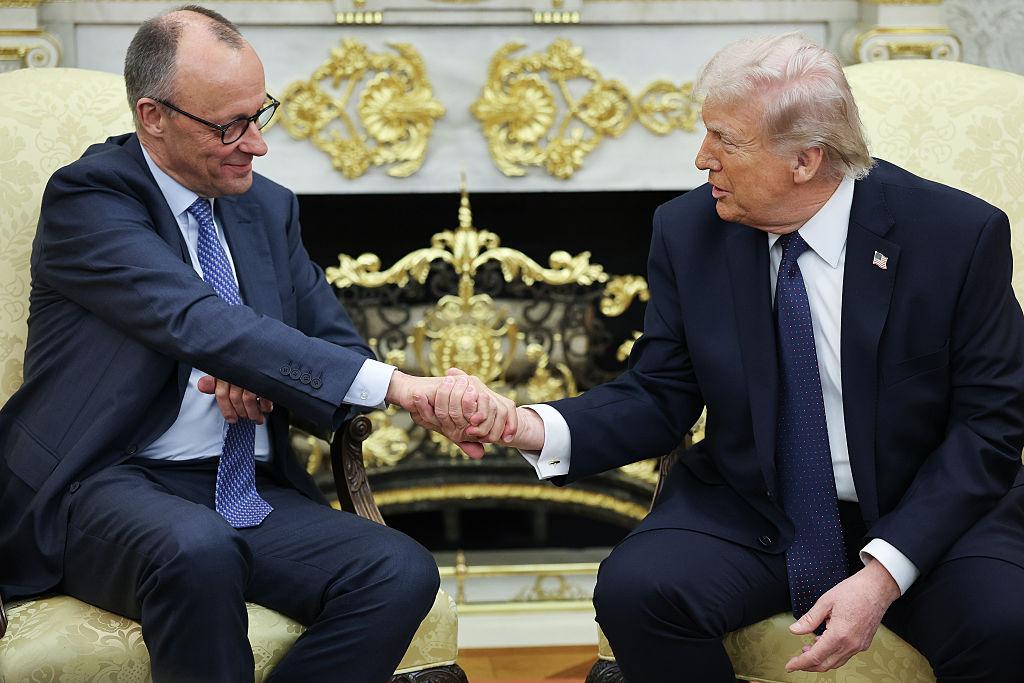
German Chancellor Friedrich Merz delivered that message directly during talks with U.S. President Donald Trump in Washington this week. The European Union, he said, remains willing to implement a previously negotiated trade agreement but will not accept revised terms that impose higher tariff burdens on European exports.
For business leaders, the warning points to a broader shift: trade policy between major economies is becoming more volatile and politically driven, forcing companies to reassess supply chains, pricing strategies and investment decisions long built on assumptions of stable cross-border commerce.
The Economic Shift
Merz’s remarks come as the Trump administration moves to design a new tariff regime after the president’s earlier framework was struck down by the U.S. Supreme Court last month. The ruling has forced policymakers to rebuild parts of the tariff system while negotiations with major trading partners continue.
European officials have been pressing to ratify the EU–US trade agreement reached last July, but the European Parliament has delayed its vote while waiting for greater clarity from Washington on the revised tariff framework.
Merz said European leaders remain committed to the agreement but warned that the bloc has reached its limit in accepting additional tariff pressure.
The episode highlights how trade policy is increasingly shaped by domestic politics, industrial strategy and geopolitical competition. For multinational companies operating across the Atlantic, that shift introduces a new layer of uncertainty around the long-term costs and reliability of cross-border trade.
Business Impact
The economic relationship between the United States and the European Union remains the largest bilateral trading relationship in the global economy.
According to European Commission trade data, EU–US trade in goods and services reached roughly €1.6 trillion in 2023 — about €4.4 billion in commerce crossing the Atlantic each day. Companies on both sides of the Atlantic also hold around €4.7 trillion in mutual investments, highlighting the depth of economic integration between the two markets.
This level of integration means even modest tariff changes can ripple quickly through global supply chains.
Exporters may face higher costs when selling abroad, while importers may need to absorb higher input costs or pass them on to customers. For companies with complex cross-border operations, shifts in tariff policy can affect logistics planning, procurement strategies and long-term investment decisions.
The sectors most exposed are those already caught in the evolving tariff framework. Automotive manufacturers and auto-parts suppliers are particularly sensitive to tariff changes, while metals such as steel, aluminium and copper continue to face higher trade barriers.
Other industries face potential exposure through national-security tariff tools and investigations, including pharmaceuticals and their ingredients, aircraft and aerospace components, semiconductors and other advanced manufacturing sectors. For companies operating in these industries, the risk lies not only in higher tariffs but also in the possibility that additional sectors could be drawn into the dispute as policy evolves.
Strategic Implications
For CEOs, the significance of the current dispute lies less in the precise tariff rates involved and more in what it reveals about the direction of global economic policy.
Tariffs are no longer used primarily as short-term negotiating leverage. Increasingly they are deployed as instruments of industrial policy, protecting strategic sectors, reshaping supply chains and influencing where investment is directed.
That shift challenges assumptions that shaped global business strategy for much of the past three decades.
Many multinational companies built their global operations on expectations of gradually declining trade barriers and relatively predictable rules. As those assumptions weaken, leadership teams must reconsider how and where goods are produced, sourced and distributed.
Some companies are diversifying supply chains across multiple regions to reduce exposure to individual trade relationships. Others are investing in regional production capacity to preserve access to key markets even if tariffs rise.
Companies that anticipate these structural shifts early may gain a strategic advantage over competitors that remain heavily dependent on vulnerable trade relationships.
CEO Takeaway
The exchange between Friedrich Merz and Donald Trump highlights a broader reality: global trade policy is entering a more uncertain and politically driven phase.
For corporate leaders, tariffs are no longer a background macroeconomic variable. They are becoming a structural constraint — shaping decisions on supply chains, pricing models, capital allocation and long-term investment.
Companies that assume stable transatlantic trade conditions may find themselves repeatedly reacting to policy shocks. Those that integrate geopolitical and trade risk into core strategy are more likely to build resilient organisations able to adapt as the rules of global commerce evolve.
For CEOs managing global businesses, the question is no longer whether trade tensions will influence corporate strategy — but how profoundly they will reshape the structure of international commerce.