
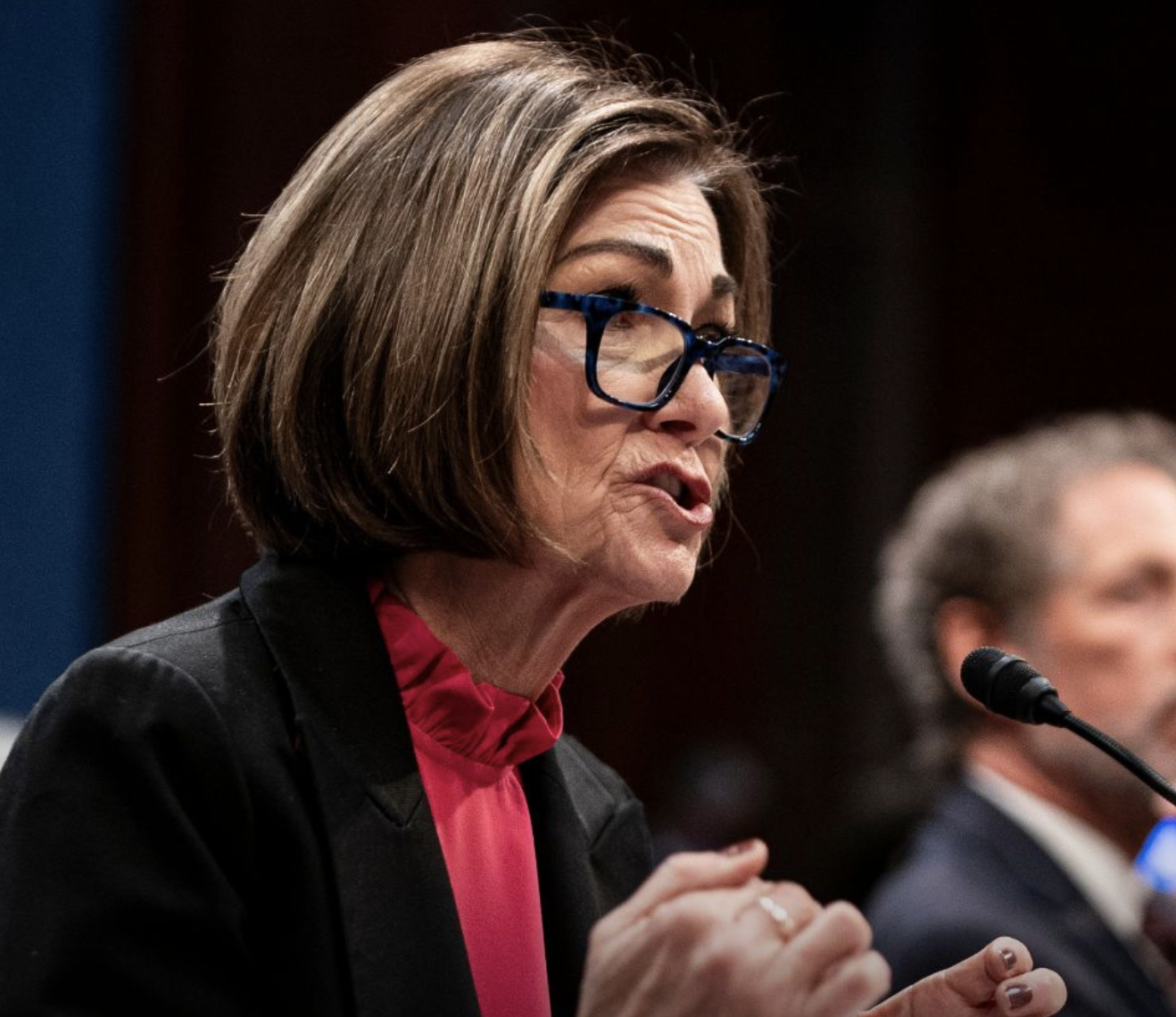
Kim Reynolds: The Governor Who Reshaped Iowa’s Fiscal Direction
Kim Reynolds is the 43rd governor of Iowa and the first woman to hold the office, a distinction that places her firmly in the state’s political history. Her tenure has been defined less by spectacle and more by sustained structural change: tax reform, education policy shifts, and a long-running effort to reposition Iowa as a lower-tax, business-friendly state.
Reynolds did not arrive in office through a rapid ascent or political dynasty. Her path was incremental, rooted in local governance, shaped by fiscal administration, and consolidated through years of statewide executive responsibility. That background continues to inform her governing style — pragmatic, conservative, and process-driven.
From County Treasurer to State Executive
Reynolds’ public career began far from the governor’s mansion. She served four terms as Clarke County Treasurer, where she oversaw local finances, tax collection, and budget administration. That experience gave her early exposure to how state and local tax policy directly affects households, municipalities, and public services.
She later won election to the Iowa Senate, where she focused on budget oversight and governance issues. Her legislative tenure was brief but strategic, positioning her for statewide office at a moment when Iowa Republicans were consolidating executive power.
In 2010, Reynolds was selected as lieutenant governor alongside Terry Branstad, who returned to the governorship after a hiatus. The pairing placed Reynolds inside the executive branch during a period of economic recovery and policy recalibration following the financial crisis.
Becoming Governor: A Historic Transition
In 2017, when Branstad resigned to become U.S. ambassador to China, Reynolds ascended to the governorship under Iowa’s constitutional succession rules. The transition was smooth but symbolically significant: she became the first woman governor in Iowa’s history.
Reynolds later secured her own mandate, winning election in 2018 and reelection in 2022. These victories confirmed her political durability in a state that has become increasingly competitive at the national level but remains structurally conservative in statewide offices.
What Has Kim Reynolds Done for Iowa?
Reynolds’ most enduring impact has been fiscal restructuring.
Under her leadership, Iowa enacted:
-
Broad income tax reductions, flattening rates and lowering overall tax burdens.
-
The elimination of inheritance tax and taxes on retirement income.
-
Reforms aimed at increasing budget predictability and maintaining state surpluses.
She has consistently argued that lower taxes strengthen Iowa’s competitiveness, retain residents, and attract employers. These policies were paired with efforts to maintain reserve funds and limit spending growth, reinforcing her reputation as a fiscal conservative rather than a deficit-driven reformer.
In education, Reynolds backed school choice initiatives, including expanded access to education savings accounts. Supporters argue these policies empower families; critics argue they redirect public funds away from traditional school systems. Regardless of viewpoint, the reforms represent one of the most significant shifts in Iowa education policy in decades.
Workforce development has also been central to her agenda, with investments in apprenticeships, skills training, and alignment between education programs and employer demand.
The 2026 Agenda: Property Taxes and Cost Pressure
In her 2026 Condition of the State address, Reynolds focused on property tax reform, responding to rising housing costs and voter concern about affordability.
Her proposal seeks to:
-
Limit local government revenue growth.
-
Reduce volatility in property assessments.
-
Provide targeted relief for seniors and homeowners.
-
Increase transparency in tax increment financing programs.
The plan reflects a broader theme of her governorship: shifting pressure away from households while forcing structural discipline on government entities.
How Long Can a Governor Serve in Iowa?
Iowa does not impose term limits on governors.
A governor may serve an unlimited number of four-year terms, as long as they continue to win reelection. Terry Branstad, Reynolds’ predecessor, served more terms than any governor in U.S. history. Reynolds herself has served since 2017 and has announced she will not seek reelection in 2026, making that election an open contest.
Has Iowa Ever Had a Democratic Governor?
Yes. Iowa has elected multiple Democratic governors throughout its history.
Notably:
-
Tom Vilsack served as governor from 1999 to 2007.
-
Chet Culver served from 2007 to 2011.
While Iowa has leaned Republican in recent statewide elections, it has a long tradition of alternating party control depending on national and economic conditions.
What Happened to the Lieutenant Governor in Iowa?
When Reynolds became governor in 2017, her lieutenant governor position became vacant. Under Iowa law, the governor appoints a replacement.
Reynolds appointed Adam Gregg, who has served as lieutenant governor since then. Gregg has focused on workforce development, job training, and education alignment, acting as a policy partner rather than a rival political figure.
Leadership Style and Political Legacy
Reynolds’ leadership style is measured and institutionally focused. She rarely frames policy around personal branding, instead emphasizing fiscal outcomes, long-term sustainability, and administrative efficiency.
Her decision not to seek another term has been interpreted less as political retreat and more as a controlled exit, allowing her to complete her agenda while shaping Iowa’s policy trajectory through the remainder of her term.
As Iowa prepares for a leadership transition, Reynolds leaves behind a state with lower taxes, reshaped education policy, and an ongoing debate about the balance between affordability, public investment, and government restraint.
Her legacy is not defined by a single reform, but by a sustained recalibration of how Iowa governs itself financially — one that will influence policy long after her term concludes.