When Saturday Night Live Sounds Like the Country Talking Back
For more than five decades, Saturday Night Live has sold itself as comedy.
In practice, it operates closer to a real-time cultural sensor.
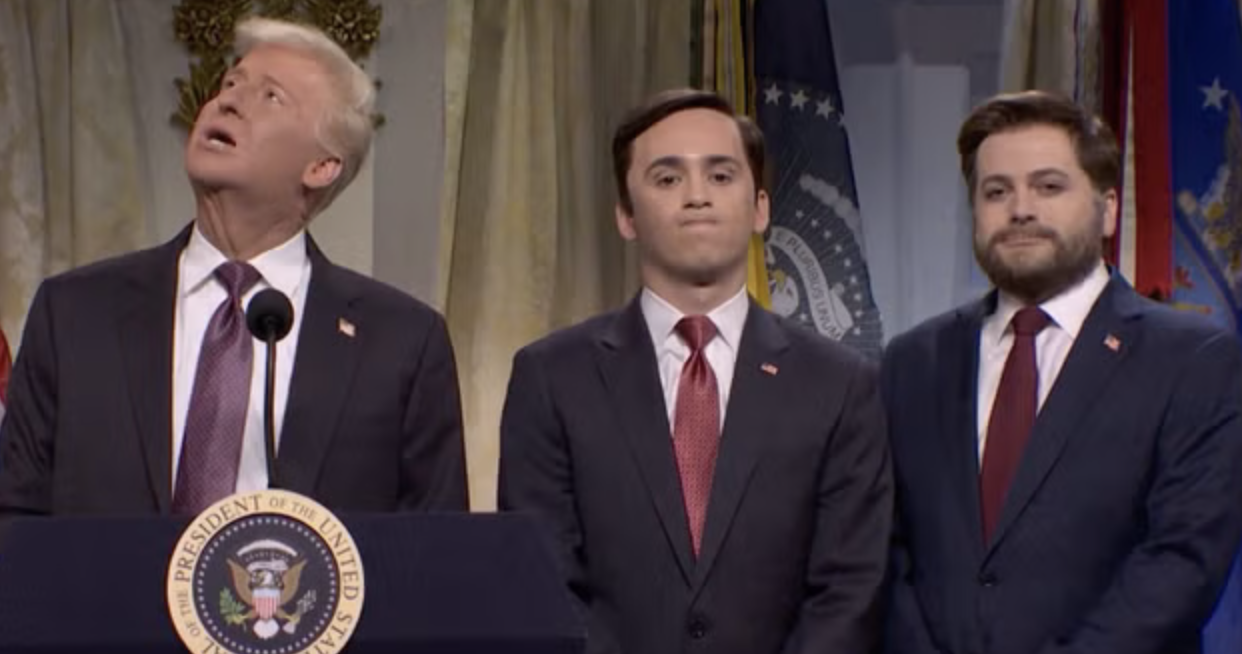
The show’s recent Trump-focused cold opens — which recycle legal gray zones, foreign policy theatrics, and enforcement crackdowns into punchlines — don’t land because they are clever alone. They land because they echo something already circulating: a mixture of disbelief, fatigue, and uneasy familiarity. Viewers don’t laugh because the jokes surprise them. They laugh because the jokes confirm what already feels absurd.
That distinction matters.
In 2026, SNL is no longer merely reacting to politics. It is interpreting public emotion under compression, translating diffuse sentiment into a shared cultural shorthand within days — sometimes hours — of events unfolding. For business leaders accustomed to dashboards, surveys, and lagging indicators, SNL functions as a different kind of signal: noisy, subjective, but often early.
Satire as Compression, Not Commentary
The strength of SNL’s political satire today lies less in critique and more in compression. Complex legal disputes, policy contradictions, and geopolitical moves are flattened into sketches that feel instantly legible. That flattening is not accidental. It mirrors how audiences themselves experience the news: fragmented, accelerated, and emotionally charged.
When James Austin Johnson’s Trump character lists accomplishments as “legal-ish,” the joke does more than mock legal ambiguity. It captures a broader public perception that institutional guardrails exist, but often bend without breaking. That perception is widespread, regardless of political alignment.
Satire succeeds when it names a feeling before people fully articulate it. SNL has become adept at doing exactly that. Not because its writers possess unusual political foresight, but because the show’s production rhythm forces rapid synthesis. Writers absorb the same headlines, social media reactions, and cable news loops as everyone else. The difference is that they are required to produce a version of it by Saturday night.
Who Decides What America Laughs At
Despite its improvisational aura, SNL is tightly governed. The show’s editorial power structure is clearer than many assume. Ideas are pitched collectively, but authority concentrates quickly.
Each week begins with a pitch meeting. By midweek, dozens of sketches exist. Most will never reach air. The filtering happens through read-throughs, rehearsals, and, ultimately, executive judgment. Lorne Michaels, along with head writers and senior producers, makes the final calls. That concentration of authority is not a flaw. It is the mechanism that gives the show coherence.
From a business perspective, this is instructive. SNL operates under extreme time pressure, reputational risk, and public scrutiny — conditions familiar to CEOs — yet it avoids decision paralysis by maintaining a clear chain of editorial command. Debate is encouraged. Finality is not optional.
The cold open, in particular, is treated as a strategic asset. It sets the tone, defines relevance, and signals what the show believes matters most that week. Choosing to lead with Trump, immigration enforcement, or foreign policy is not a neutral act. It reflects an editorial assessment that these topics dominate the cultural bloodstream enough to justify prime placement.
The Illusion of Representation — and Why It Works
Critics often argue that SNL reflects only a narrow slice of public opinion. That is partly true. The show’s writers, cast, and audience skew urban, educated, and media-literate. Yet the sketches resonate far beyond that core because they trade in recognizable emotional cues rather than ideological arguments.
SNL does not ask viewers to agree. It asks them to recognize.
Recognition is powerful. It creates the sensation that “everyone is seeing this,” even when audiences disagree about what it means. That sensation explains why political figures respond to SNL sketches with irritation, delight, or strategic silence. Being parodied on SNL signals cultural centrality. Ignoring it does not make it disappear.
For leaders in business or politics, this dynamic mirrors reputational reality. Visibility amplifies scrutiny. Absence invites interpretation. There is no neutral ground.
Comedy as a Risk-Free Proxy for Dissent
One reason SNL feels aligned with public feeling is that it provides a low-risk outlet for dissent. Laughing at a sketch is easier than articulating a position. Sharing a clip is safer than writing an essay. Satire allows audiences to participate in critique without committing to policy prescriptions.
That function has grown more important as trust in institutions erodes. When formal channels feel inaccessible or ineffective, cultural ones absorb pressure. SNL becomes a place where contradictions are aired without resolution — a release valve rather than a roadmap.
This does not make the show radical. It makes it adaptive.
Why Executives Should Pay Attention
For business leaders, the takeaway is not to treat SNL as a moral authority. It isn’t. The value lies in pattern recognition.
When a sketch resonates widely, it often indicates that a narrative has already escaped official messaging. Public perception has moved. Reputational terrain has shifted. In that sense, SNL functions less like a comedian and more like a weather vane.
Ignoring that signal is a mistake leaders have made before.
The Enduring Advantage of Live Judgment
In an era dominated by algorithms and delayed analytics, SNL’s greatest advantage is human judgment under deadline. Writers decide what feels true enough to risk saying out loud. Producers decide what is worth standing behind live. Mistakes happen. Corrections come later. But the immediacy is the point.
That immediacy explains why SNL still matters when so many legacy formats do not. It trades perfection for relevance. It absorbs backlash as part of the process. It understands that cultural authority is temporary and must be renewed weekly.
Conclusion: Not a Mirror, a Pressure Gauge
Saturday Night Live does not simply reflect public feeling. It measures pressure.
It shows where tension has built, where disbelief has settled, and where irony has replaced outrage. For viewers, it offers laughter. For leaders paying attention, it offers something else: an unfiltered read on how reality is being emotionally processed at scale.