

Kostiantyn Shurupov
an expert in digital marketing and affiliate business development
Introduction
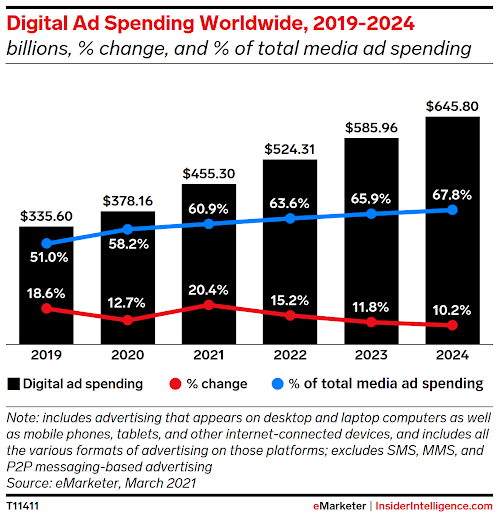
In recent years, businesses have been experiencing both digital and regulatory transformation. On the one hand, global advertising spending is growing and has already reached around USD 1.1 trillion, with digital contributing the majority of the increase. On the other hand, regulatory control is tightening, restrictions on advertising financial services, gambling, and related verticals are expanding, and KYC/AML and audience communication requirements are becoming stricter.
In such an environment, classical approaches—large image-building campaigns, broad offline activations—are gradually giving way to more targeted, measurable, and flexible working models. One of them is affiliate marketing: a model in which partners receive compensation for specific user actions—registration, deposit, subscription.
For companies in regulated niches, affiliate marketing is especially attractive. It allows shifting part of the risks and costs of traffic acquisition to partners while maintaining control over messaging and traffic quality. However, this works only if a system is built: clear KPIs, transparent analytics, a well-designed funnel, and close interaction with partners.
- Global Trends: Where Digital and Affiliate Marketing Are Heading
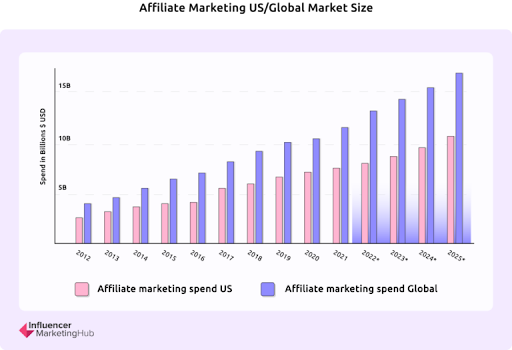
According to industry analysts, the global affiliate marketing market already exceeds USD 17 billion and will continue growing until the end of the decade. At the same time, the affiliate channel accounts for roughly one-sixth of online orders in the United States, making it one of the key drivers of e-commerce.
A related segment is also growing—influencer and creator marketing. Estimates of the influencer marketing market in 2024 fall in the range of about USD 24 billion, reflecting the stable demand from brands for native formats and collaboration with content creators. For the affiliate ecosystem, this means a shift of focus from classical coupon sites toward bloggers, streamers, media, and communities.
For top management, the key conclusion is simple: affiliate and digital channels are no longer auxiliary directions. They are a full-fledged strategic asset, and the architecture behind them determines business resilience—especially in niches where other channels are restricted by law.
- Growth Strategies in Highly Regulated Niches
In highly regulated verticals—from fintech to online gaming—marketing constantly balances between aggressive growth targets and compliance requirements. Practice shows that a combination of three approaches delivers stable results.
2.1. Compliance by Default (Compliance-by-Design)
A flawed logic in highly regulated markets is to “squeeze the maximum” out of marketing first and then negotiate with the legal team afterward. In conditions where a regulator can shut down the business or block domains, the strategy must be the opposite: all acquisition mechanics are designed from the outset with legal restrictions in mind.
This means:
- strict standards for promotional materials and partners’ advertising messages;
- a centralized library of approved creatives;
- automatic checks for geo, age restrictions, disclaimers;
- traffic monitoring for violations of platform rules and regulatory requirements.
2.2. Multichannel Funnel and the Role of Partners
Affiliate partners do not replace other channels—they complement them. The funnel is built so that it becomes easier for the user to make a decision: content media address informational objections, bloggers build trust, and product advertising demonstrates value.
A partner receives not only a tracking link but also:
- clear product positioning;
- ready-made communication scripts;
- tested landing pages tailored to their audiences;
- access to analytics on traffic quality.
3. Online Gaming and Poker: A Case of a Highly Competitive and Regulated Market
The online gambling market shows stable growth: the volume of the global market was already estimated at tens of billions of dollars in 2024, with a forecast of doubling by the beginning of the next decade.
A separate segment is online poker, whose global market in 2024 was estimated at about USD 5.3 billion, with a projected growth of more than twofold by 2030.
Poker is an example of a product where strict regulation, the need to work with responsible gambling, and extreme competition for the user all coexist. In such conditions, affiliate marketing becomes one of the few tools that allows scaling growth without constantly increasing bids in auctions.
Practice shows that in such verticals the following are especially important:
- careful segmentation of partners (professional affiliates, streamers, communities, educational platforms);
- a well-structured system of multi-level rewards based on the LTV of referred players;
- transparent anti-fraud mechanisms and regular traffic audits;
- close product alignment: changes in the game’s economics are immediately reflected in offers and communication.
Conclusion
Digital and affiliate marketing in highly regulated niches are not a tactical set of tools but a strategic growth framework. Global statistics show sustained growth in digital spending, the affiliate marketing market, and the online gaming industry, which means that competition for user attention will only intensify.
In such conditions, the winners are not the companies that pay partners the most in the short run, but those that build a systematic approach: compliance-by-design, transparent analytics, a partner ecosystem, and a product that adapts to real data. For executives making budget allocation decisions, it makes sense to view affiliate marketing not as an “experimental channel” but as a foundational part of the business—capable of withstanding both regulatory shocks and market fluctuations.
Sources
- Digital 2025: Global Advertising Trends, Statista / Datareportal, 2025. DataReportal – Global Digital Insights
- Authority Hacker / Ahrefs. Affiliate Marketing Statistics 2024. Ahrefs
- Wix. Affiliate marketing statistics and facts for 2025. wix.com
- Industry reports on global influencer marketing market, 2024–2025. Oberlo+1
- ResearchAndMarkets.com. Online Gambling Industry Report 2025. Business Wire
- Yahoo Finance. Online Poker Global Strategic Business Report 2025–2030.